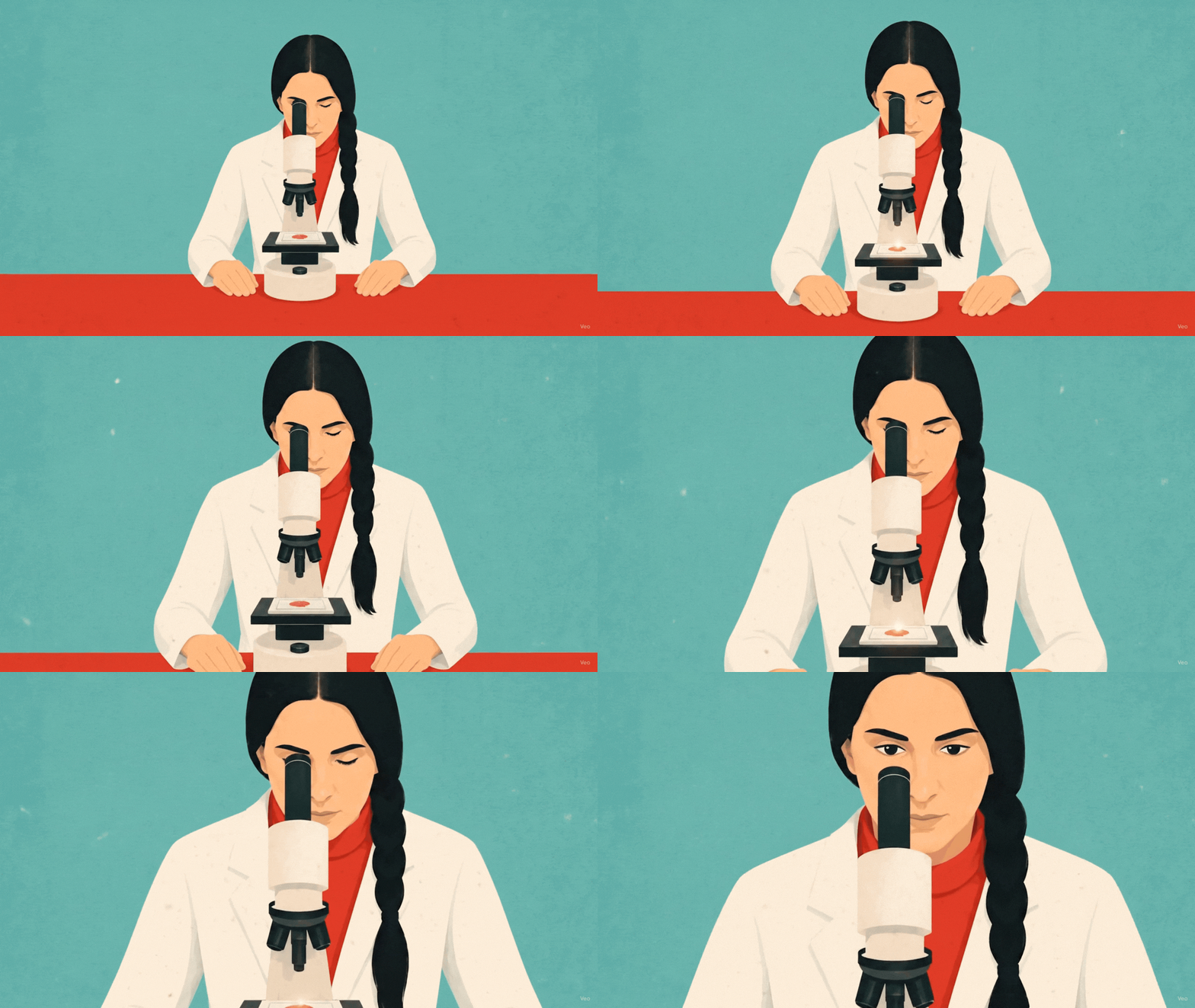
We analyzed biographies, press releases and gallery texts to understand how the contemporary artist became a researcher, an archivist, a community activator, a political device.
Nobody paints, everybody does research
The Facts
"Her interdisciplinary practice interrogates the relations between body, archive and collective memory, activating spaces of care within postcolonial ecologies."
A sentence like this one you can find in dozens of press releases from the most sought-after galleries in the world. In many cases it describes something the artist genuinely does. The problem is not the lie. It's that this sentence could describe almost anyone.
Artists used to paint, sculpt, photograph, draw. Today they "probe," "traverse," "interrogate," "activate," "throw into crisis." It's not just a matter of jargon. It's the way contemporary art produces symbolic value: before it is even seen, the work has to be made legible as research.
The Precedent
International Art English, 2012
The phenomenon has a name and a date. In July 2012 Alix Rule and David Levine published a linguistic analysis on Triple Canopy that immediately became a landmark: International Art English. The corpus: every e-flux press release from 1999 to 2012, analyzed with Sketch Engine and compared against the British National Corpus. The finding is that the international art world uses a language that has everything to do with English, but is not English. "An artist's work inevitably interrogates, questions, encodes, transforms, subverts, imbricates, displaces."
One figure stands out: the word "real" appears 2,148 times per million units in the e-flux corpus against twelve in the British National Corpus — one hundred and seventy-nine times more. Everything is real because declaring it is the way to assert that you make serious art.
The Corpus
2024: the grammar stayed, the lexicon widened
We compared that corpus with a sample of bios from primary galleries — David Zwirner, Gagosian, Kurimanzutto — updated to 2024. The grammar stayed the same, the lexicon widened. Alongside the historic IAE words came the ones of the decade: care, ecology, displacement, decolonial, community. Oscar Murillo "constantly probes questions of collectivity and shared culture." Adrián Villar Rojas "explores the conditions of a humanity at risk, tracing the multi-species boundaries of a post-anthropocene time." All plausible, perhaps all true. And all identical in register: the one who runs workshops in outlying neighborhoods and the one who paints abstract canvases in the studio use the same words, the same verbs, the same syntactic curves.
The words that count
practice · research · archive · body · memory · community · care · ecology · displacement · materiality
The contemporary artist's verbs
explores · investigates · interrogates · questions · challenges · reconfigures · activates · engages
The Analysis
As Michael Kowalski observed in Salmagundi in 2022, "practice" works as an anti-description: it replaces painting, sculpting, drawing with a category broad enough to say nothing at all. Art really has become more processual and relational since the Nineties — the lexicon changed because the practices changed. But the language born to describe ended up prescribing. As David Levine noted in The Guardian in 2013, "the more overheated the market gets, the more overheated the language gets." The market did not adopt this lexicon because it understands it. It adopted it because it works as a signal of legitimacy.
In the world of contemporary art the work is no longer enough to exist. It has to have a practice.
The Vocabulary
The perfect sentence of contemporary art
"Her interdisciplinary practice interrogates the relations between body, archive and collective memory, activating spaces of care within postcolonial ecologies and throwing into crisis the narratives of diasporic subjectivity."
Built by combining the dominant formulas of the analyzed corpus. It could be true.
Translation into plain English
Examples built on the patterns documented by Rule and Levine, not quotations from specific bios.
Original In plain English "a site for sustained inquiry into protest strategies and activist discourse" a place where people talk about how to do activism "interrogates the devices of collective memory and the tensions between archive, body and territory" uses photographs and found objects to tell local stories "activates spaces of care through participatory practices and processes of community regeneration" runs workshops and gatherings in struggling neighborhoods "throws into crisis colonial narratives through the symbolic restitution of plundered archives" collects objects looted during colonization and displays them to denounce their removal "explores the tensions between the post-anthropocene and the forms of life emerging from the global ecological crisis" makes sculptures with organic materials that rot over time and watches what happens "investigates the relations between diasporic identity, intergenerational cultural transmission and the construction of subjectivity in migratory contexts" paints portraits of people from his family and the Nigerian community he grew up in
Sources
Alix Rule, David Levine, "International Art English," Triple Canopy, July 2012. canopycanopycanopy.com
Michael Kowalski, "The Praxis of Practice," Salmagundi, no. 216-217, Fall 2022–Winter 2023.
David Levine, quoted by Andy Beckett, "A user's guide to artspeak," The Guardian, 27 January 2013. theguardian.com
Oscar Murillo, artist bio. Kurimanzutto / David Zwirner. kurimanzutto.com
Adrián Villar Rojas, artist bio. Marian Goodman Gallery. mariangoodman.com
``` --- **rivoluzione-comunicato.html** ```html
The political-identitarian lexicon is not just critical content: it has become a grammar of legitimation. Words like care, archive, trauma, decolonial, ecology, community, body work as signals of contemporaneity.
The revolution as press release
The Facts
The revolution does not always enter museums with a picket line. Sometimes it arrives in the form of a press release, with the right words — care, archive, trauma, decolonial, ecology, community, body — arranged in the right sequence.
The Figure
That value in contemporary art is built more through career signals than through the works themselves is now documented quantitatively. A study published in Scientific Reports in 2024 by Kangsan Lee and colleagues analyzed 34,200 auction transactions, 590 living contemporary artists, 23 countries, over a span of seventeen years. Social signals — representing gallery, awards, museum shows, institutional career — explain 73% of price variation. The visual features of the work explain 5.5%. In emerging markets the weight of social signals is greater still. The paper concludes that the value of the work is largely determined by social factors, and that there are no universal visual features capable of signaling its quality or its value.
The data concern the market, not language. But if value is built by social signals, the lexicon that builds and transmits those signals is one of those mechanisms — and it's worth saying so explicitly, because it isn't obvious. Mastering the right words is not incidental to the career. It is part of the career.
The Counterargument
When Hito Steyerl replied to Rule and Levine on e-flux in 2013, she said they were wrong: that language was not the language of insiders, it was the language of migrants and interns, born in the peripheries of the system. It's a serious objection. And yet in the same text she ended up conceding that IAE sustains oppression and exploitation, and that it legitimizes the use of contemporary art by the 1%. The two things are not mutually exclusive: a language can be born at the margins and become the calling card of the center.
The art market does not neutralize politics by censoring it. It neutralizes it by turning it into a keyword.
Sources
Kangsan Lee, Jaehyuk Park, Sam Goree, David Crandall, Yong-Yeol Ahn, "Social signals predict contemporary art prices better than visual features, particularly in emerging markets," Scientific Reports, 2024. DOI: 10.1038/s41598-024-60957-z
Hito Steyerl, "International Disco Latin," e-flux journal no. 45, May 2013. e-flux.com/journal
Alix Rule, David Levine, "International Art English," Triple Canopy, July 2012. canopycanopycanopy.com
```