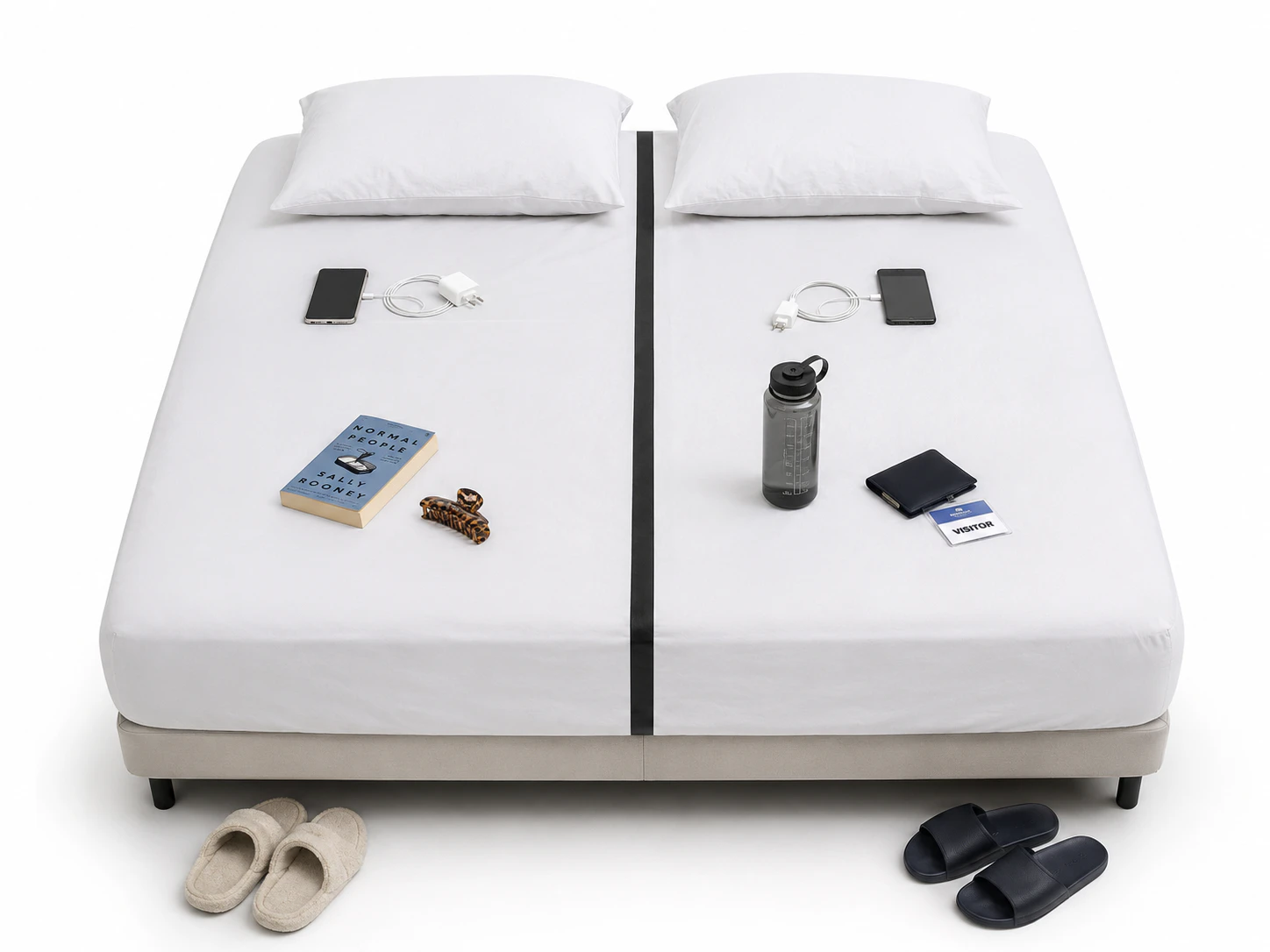
Reuters reports on a twenty-five-year-old woman, Winnie Zeng, who works in sales in Wuhan and earns 4,000 yuan a month. To save money, she looked for someone willing to share not just the room, but the bed. Her flatmate is the same age; before moving in, the two agreed on an eight-day trial. The arrangement saves her 450 yuan less (about 60 euros) every month.
The practice remains marginal among China's roughly 260 million renters, but on social media it has found an enormous audience. On Weibo, a hashtag dedicated to the topic has surpassed 14 million views; on Douyin, related content has reached nearly 40 million. Sharing a kitchen and bathroom is by now ordinary in big cities. The bed still seemed like a taboo.
Behind this forced intimacy lies a larger problem. In 2026, Chinese universities produced a record 12.7 million graduates, 480,000 more than the previous year. Since 2022, more than ten million have graduated every year: a population equivalent to that of a medium-sized European country, which must enter an already saturated market. The difficulties hit hardest those who studied humanities, arts and languages, while demand is concentrated in electric vehicles, batteries, semiconductors and robotics. Even entry-level tech positions are increasingly exposed to automation.
Between 2021 and 2025, universities cut 12,200 courses, mostly in the arts and humanities, while introducing 10,200 in emerging sectors. It is the paradox of a country that invested in mass education and is now rapidly treating some of the skills it trained as obsolete. Many graduates end up in gig work or delivery jobs, with the risk that degrees and abilities lose their value.
Sharing a bed is therefore not a new sharing economy. No one is monetising unused space: people are shrinking the space they need to live. It is an adaptation to the fear of losing one's income, not a new communal ideal.
Zeng says it is nice to have someone waiting for her at home. It may be that genuine companionship grows out of necessity. But the decisive detail remains economic: two young working women sleep in the same bed to buy, every month, a little security about the future.
