A few days ago I saw some screenshots in which Sam Altman was asking a guy he'd met on Grindr for oral sex. Altman is married, and the story had every ingredient of a gossip piece: sex, betrayal, a very powerful man, and a private conversation that had ended up online.
My first reaction was: so what? Altman is gay, Grindr is a gay app, and his sex life is none of my business. That was a reasonable response — and also a way to keep reading without admitting I was reading precisely because the story was juicy. On one hand I rejected the moralism of the alleged scandal; on the other I was waiting for the next screenshot.
Only later did I ask myself the most basic question: had any of this actually happened?
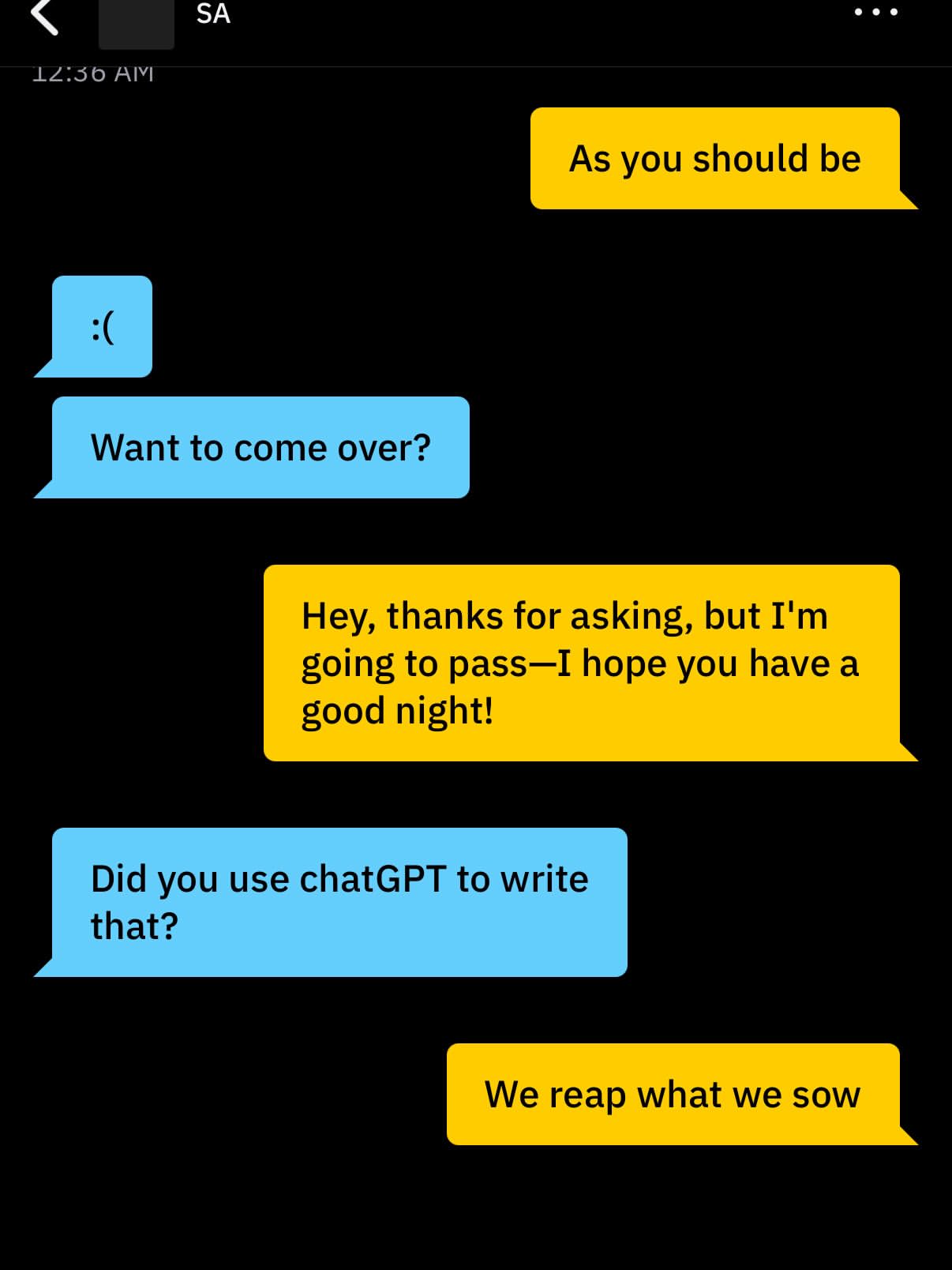
In the screenshots the alleged Altman said he was «lonely and horny». Jake Schroeder, the creator who had posted the conversation, turned him down gently; at that point Altman asked him whether he'd used ChatGPT to write the reply. The joke landed, and the situation felt plausible. Meanwhile, the Grindr detail shifted my attention: instead of asking whether the conversation was real, I had already moved on to thinking about what it meant.
In the following days Schroeder, known online as FrostedJake, kept adding new chapters. He showed what was supposedly a legal email from OpenAI's lawyers, described a Zoom meeting, and finally posted what was presented as the company's offer to make the whole thing go away: $500 and an OpenAI branded hoodie. Along the way he turned every development into a comic ballad, building a serialised story that thousands of people followed waiting for the next instalment.
With each update the episode grew less credible, but also harder to put down. I looked for confirmation and found none: no article, no public statement from OpenAI, no independent proof of the emails or the negotiation. Yet the absence of any corroboration wasn't enough to close the story, because we're used to news breaking on social media before it reaches the press. An unverified screenshot can be a fabrication — or the first document of something no newsroom has checked yet.
I started to wonder whether the whole thing might be a performance about uncertainty. Schroeder didn't need to convince everyone: he just had to keep adding details without ever offering a definitive answer. But there was still a much older explanation — older than artificial intelligence: a creator had found a lie that could get him attention, and had decided to stretch it out.
The episode ended when Vulture contacted OpenAI. According to the outlet, a company spokesperson said the posts were fake and that OpenAI had had no interaction with Schroeder whatsoever. At that point the interesting part was no longer about Sam Altman — it was about the work required to establish that the story had never happened.
Schroeder hadn't produced a deepfake, cloned a voice, or generated a video. He had posted some screenshots and built a narrative around them. The mere possibility of fabricating such a story had nonetheless changed the way we looked at those materials: we knew they could be fake, but we didn't have enough to rule out that they were real.
AI didn't create this story; it helped create the environment in which a story like this can stay plausible for longer. Platforms distribute the content, the creator benefits from the uncertainty, and the cost of verification falls on the viewer, who has to find other sources and reconstruct the context. Of course, this story also tells us that when we want to believe something, we do.
We can still find out what happened — but it takes time, attention, and fact-checking. Spinning up the Sam Altman Grindr saga took a handful of screenshots and a few songs; shutting it down required a newsroom to call OpenAI. In the AI era, verifying reality is becoming a job, even when the story being verified barely matters.